


What I See Before I Press the Shutter
There is a moment that happens before every photograph.
It is the moment when I notice something.
It might be a shaft of light falling across a leaf. A curved stem disappearing into the background. Two colours sitting unexpectedly well together. The glow of something backlit. A movement that catches my eye. Or sometimes, something I cannot quite explain — a feeling that makes me stop.
The camera comes later.
This is something I have become increasingly aware of over the years. When I am out photographing, I am rarely thinking first about aperture, shutter speed or even the subject itself. My attention is drawn towards something much less tangible.
I am looking for relationships.
Before the subject, there is the light
Light is often the first thing I notice.
Not necessarily dramatic light. In fact, some of my favourite light is incredibly subtle — a soft glow filtering through foliage, a patch of brightness behind a flower, or the gentle illumination that appears when the sun is low.
I might see a small area of light in the distance and wonder what could happen if I placed something in front of it.
At that point, I am not necessarily photographing the flower, leaf or stem.
I am photographing the light interacting with it.
This distinction is important.
The subject gives me a starting point, but the light often determines what the photograph will become.

Then I start looking for lines
Lines are everywhere.
A stem curves upwards. A branch reaches across the frame. A blade of grass bends in the breeze. A row of trees creates a rhythm in the distance.
Sometimes I follow those lines with my eyes before I even raise the camera.
Where do they lead?
Do they create movement?
Do they intersect with another shape?
Could I emphasise their direction through camera movement?
This is particularly important when I am working with ICM. The movement of the camera does not begin with pressing the shutter. It begins with seeing the direction already present in the scene.
If I find a beautiful vertical rhythm, for example, I might instinctively want to move vertically with it.
The movement becomes a continuation of what I have already seen.

Colour speaks before detail
There are also moments when colour catches my attention before anything else.
Perhaps it is a small area of intense colour surrounded by muted tones. Perhaps two colours appear together in a way that feels almost surprising.
At those moments, I don’t necessarily want to record every detail.
I may want to simplify.
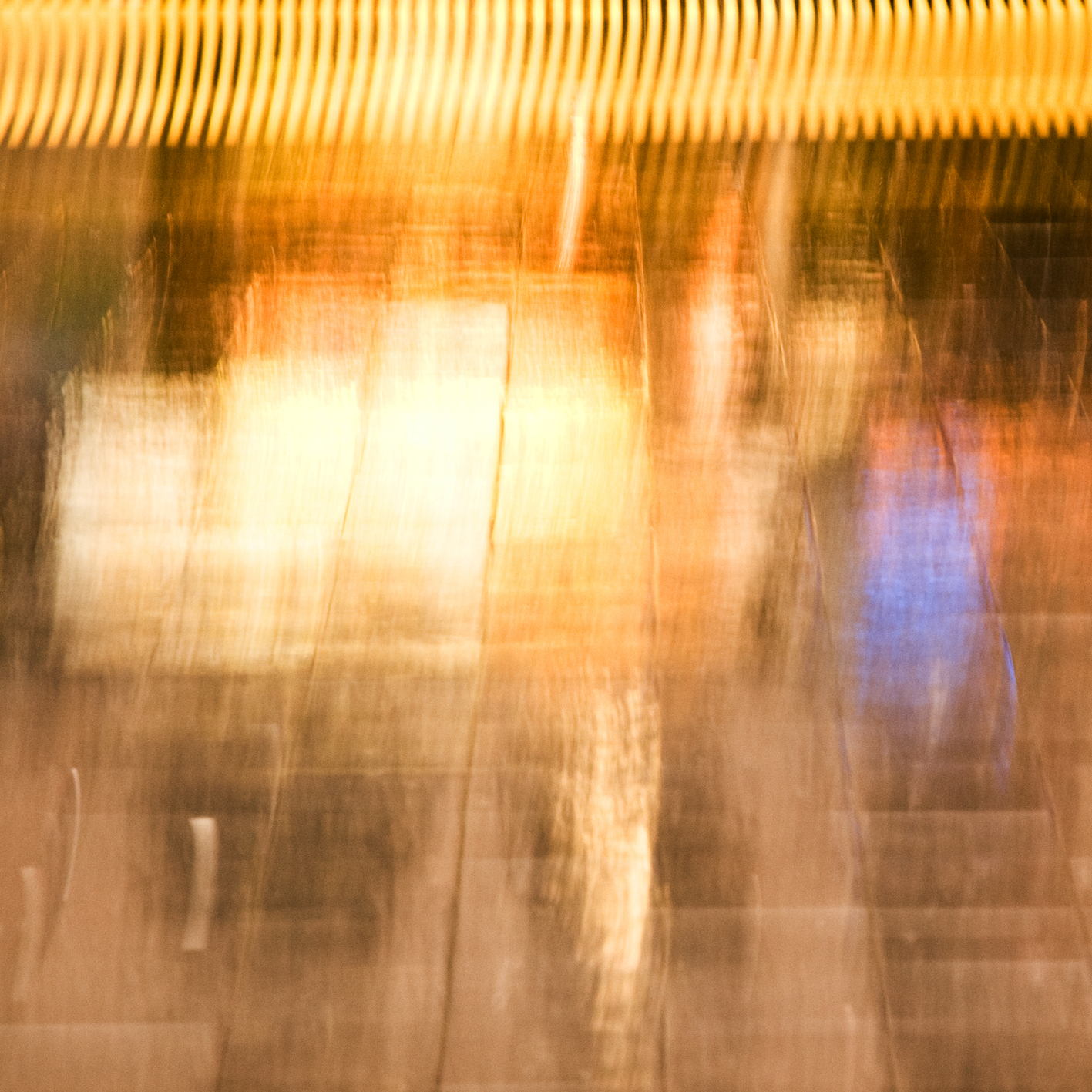
To allow the colours to blend, overlap or become almost abstract.
This is one of the reasons I love Impressionist photography. It gives me permission to respond to colour emotionally rather than photographically.
Instead of asking, “What is this?”
I can ask,
“What does this colour combination make me feel?”
I look for shapes rather than objects
This is something that has changed significantly in the way I photograph.
I used to be much more conscious of the subject itself.
A flower was a flower.
A tree was a tree.
A mushroom was a mushroom.
Now I often see the shapes before I see the objects.
A dome.
A circle.
A curve.
A delicate vertical line.
A dark silhouette against a luminous background.
A cluster of overlapping forms.
Once I start seeing the world this way, ordinary subjects become much more interesting.
A damaged leaf can suddenly become an elegant shape.
A bent stem can become a sweeping line.
A partially hidden flower can create more mystery than one that is completely visible.
The subject doesn’t have to be extraordinary.
The way I see it can make it extraordinary.

Sometimes it is movement
There are occasions when the first thing I notice is not something static at all.
It is movement.
Leaves trembling in the breeze. Long grass moving gently from side to side. Falling leaves. Branches swaying against the sky.
Movement gives me another possibility.
Instead of trying to eliminate it, I can work with it.
I might use a slow shutter speed and allow the movement to become part of the image. Or I might move the camera myself, deliberately introducing another layer of movement.
The important thing is that I am responding to what is already happening.
I am not simply applying a technique because I know how to use it.
The scene is suggesting something to me.

And sometimes I notice a feeling
This is perhaps the hardest thing to explain.
Occasionally I stop because a scene simply feels right.
There may be nothing obviously remarkable about it.
The light is ordinary. The subject is ordinary. The composition may not even be immediately obvious.
And yet something about the moment makes me pause.
Perhaps it feels quiet.
Or fragile.
Or joyful.
Or mysterious.
Or fleeting.
I have learned to pay attention to that feeling.
Because sometimes the feeling is the photograph.
The technical decisions that follow — the lens, the focus, the movement, the exposure — are simply ways of trying to translate that feeling into an image.

The photograph begins before the camera
This is why I believe that improving as a photographer is not only about learning more techniques.
Technique matters. Understanding your camera matters. Knowing what your equipment can do gives you freedom.
But before all of that comes attention.
What are you actually noticing?
What makes you stop?
Are you drawn to colour, light, shape, texture, movement or atmosphere?
Do you instinctively look for details, relationships, patterns or empty space?
And perhaps most importantly:
What are you feeling when you look at the scene?
The more closely I pay attention to my own responses, the more I understand what I am trying to say with my photographs.
And this has changed the way I walk with a camera.
I no longer feel that I have to find something spectacular.
I can photograph something familiar.
Something small.
Something imperfect.
Something that other people might walk straight past.
Because I am not simply looking for a subject.
I am looking for the moment when something speaks to me.
And only then do I raise the camera.
The photograph begins with seeing.
The shutter simply records what happens next.
Take a moment to think about your own photography: what catches your eye first?


About Post Author
