


Finding your own unique way in impressionist photography
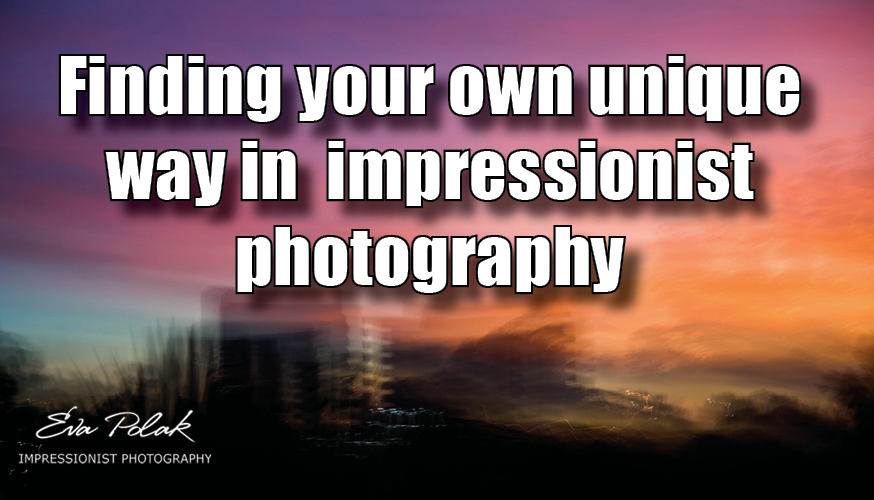
There is nothing more fundamental to a photographer than choosing what subject you feel most deserves your time and attention. What we choose to photograph says as much about us as anything else we may do.
In the beginning of your artistic journey, it’s easy to be influenced by those who you admire. You might believe that they have the answers, and you want to emulate them. This is a natural way to develop technical skills and discover what kind of artist you may wish to become, but at some point in your journey you need to find your own way.
My belief is that it doesn’t matter what subject you photograph — or even what you are photographing with — but how you see what you photograph and how you express it. I’ve spent countless hours playing in my photoshoots, experimenting with tools and techniques just for the joy of exploring. Honestly, if I had only one subject to photograph for the rest of my life, my goal would be to make it a new experience each time I photograph it, and I would try to find as many ways as I could to make each one unique and beautiful.
My approach to photography has dramatically changed since I was introduced to impressionist photography. I have reconsidered everything I thought I knew about photography in order to free myself from negative judgment and expectations, and it has been a transformative experience. I now feel more excited to create images than ever, and I can’t wait to see what will happen in each photoshoot!

I’d like to challenge you to question what an impressionist image is or could be. I’d like you to go back to using simple techniques and tools and do a lot of experiments. Each time you do so, you’ll find you can let go of expectations, relax and enjoy the process of creating images. Any time you are trying a new technique, lens or process take the time to find out the full range of what it can do. Find possibilities as well as the limitations each tool can offer you.
Anyone who has ever tried to make something has experienced both the frustration and the reward that go hand in hand with the process: the elusive nature of creativity, the search for the muse, the gut-wrenching disappointment when things don’t go as planned, and the moment when vision and execution merge into great image.
I love it when I feel like an explorer during my photoshoot. “What will happen if …?” is a question I often ask myself. I‘ll explore a lot of possibilities and make lots of ‘mistakes’ to discover what does or doesn’t work. The truth is that if I’m not willing to take risks and try new things, I will be stuck to repeating those techniques I know have worked in the past. The process of exploring means making loads of mistakes, and along the way, I discover wonderful possibilities. This approach is inherently linked to my personal growth as an artist, and I hope you too find this process as liberating as I do.
Many of my students are often limited by their exposure to impressionist photography ‘methods.’ If challenged to produce fifty different versions of the same image, they might quickly exhaust their repertoire after five or ten images. The images below demonstrate that the way you photograph something alters the way you convey the impression of a subject. It is not a matter of capturing more or less detail, but how you use the light, angle of view, exposure and your own personal touch that makes your art unique. Learning to photograph never stops, and you should be constantly on the lookout for new possibilities.
If I could give you one piece of advice — try not to photograph the subjects or scenes in front of you. Try to photograph the light that illuminates and gives them life. Find inspiration in abstract patterns of light and shade.
It is very easy to assume that if an object or a scene is not immediately seen as beautiful, then it is unworthy to be captured in a photograph. But this simply isn’t true. Some of my images are the result of being inspired by something that may have eluded my attention the day before without earning a second thought.

You don’t need to travel to some exotic places; there are more than enough subjects right in your own backyard. Fantastic impressionist photographs are to be made from the most humble and commonplace objects around you. Subjects like those often make for the most personal and expressive works.
It‘s not what we see, but how we see. Art really is all around us, everywhere — just waiting to be discovered.


About Post Author
