


The Photograph I Almost Didn’t Take
There are photographs I remember taking because everything came together perfectly — the light, the subject, the weather, the movement, all arriving at once as if the world had arranged itself for me. And then there are photographs I remember for the opposite reason: because, at first, I almost walked past them.
This is the story of one of those.
An Ordinary Morning
I was out photographing in a familiar place — somewhere I had visited many times before, camera in hand, half-expecting nothing new. I remember the particular flatness of that feeling: not frustration, exactly, but a quiet disappointment. I knew this place. I knew its corners and its light and its usual offerings, and that morning, none of it seemed to be offering anything at all.
The scene looked ordinary. The leaves were just leaves. The path was just a path. Nothing raised its hand and asked to be photographed.
It would have been easy to leave. I have left places like this before, telling myself there was nothing there, that today simply wasn’t the day. But something — habit, or curiosity, or simple reluctance to waste a walk — made me slow down instead.
What Changes When We Slow Down
And that is where the photograph began. Not with a subject, but with a pause.
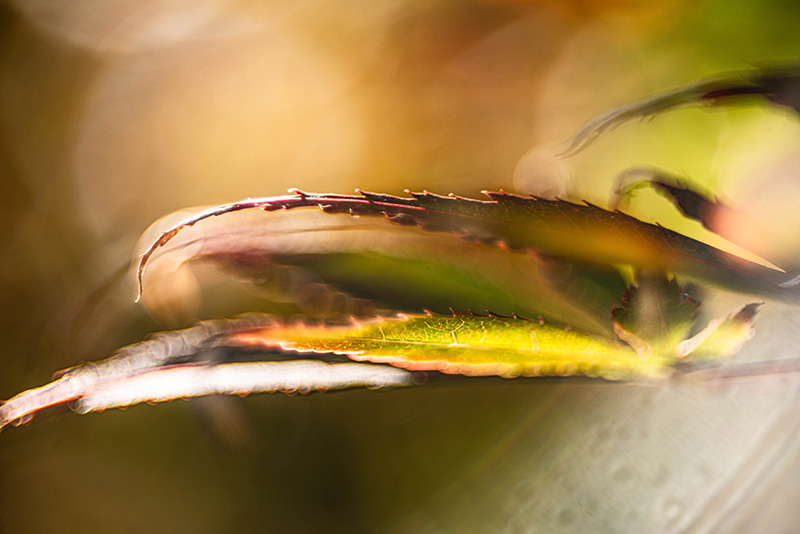
As I stood there, no longer scanning for something obviously photogenic, I started to notice things I had walked past a dozen times before. The morning light was touching the leaves in a particular way — not dramatic, not golden-hour spectacular, just soft and quietly attentive. The leaves were moving gently in the breeze, and behind them, the background was dissolving into loose, indistinct shapes of colour.
None of this would have shown up in a straightforward, literal photograph. It only became visible once I stopped looking for something and started simply looking.
This is, I think, the real difference between the photographs that come easily and the ones we almost miss. The easy ones announce themselves. The others need us to change how we’re looking before they’ll appear at all.
Asking a Different Question
Instead of photographing the subject as I saw it — leaf, branch, light, in their ordinary arrangement — I asked myself a different question: What does this moment feel like?
That single shift changed everything. I wasn’t trying to document the leaves any more. I was trying to translate a feeling — the softness of the light, the slight tremor of movement, the sense of a morning that was gentle rather than dramatic.
I used a shallow depth of field as I pressed the shutter, letting the precise edges of the leaves dissolve into something looser and more suggestive. And the familiar scene suddenly became something else entirely. The leaves were no longer simply leaves. They became flowing lines, colour, light and movement — an impression rather than a description.
What the Photograph Taught Me
That photograph has stayed with me, not because it is the most technically accomplished image I’ve made, but because of what it reminded me of — something I seem to need to learn again and again in this practice: the most interesting images are often hidden inside the subjects we think we already know.
We don’t always need a new location, a rare subject, or spectacular light to make a photograph worth keeping. Sometimes what we need is simply to look differently at what is already in front of us — to trade the search for the obvious photograph for a genuine curiosity about what else might be possible within an ordinary scene.
This is, I think, one of the great quiet gifts of impressionist photography. It doesn’t ask you to travel further or wait for better conditions. It asks you to stay a little longer with what’s already there, and to let your question change from what is this? to what does this feel like?
A Small Invitation
The next time you find yourself somewhere familiar — a garden you’ve photographed a hundred times, a street you walk every day — and feel that same flatness, that sense that there’s nothing left to see, I’d gently suggest not leaving just yet. Slow down. Let your eyes soften. Ask the scene how it feels rather than what it looks like.
You might almost walk past the photograph. But if you stay a moment longer, it may well be waiting for you, quietly, inside the place you thought you already knew.
Perhaps you have experienced something similar.
Have you ever been about to walk past a scene because it looked ordinary, only to discover something unexpected when you slowed down and really looked?
I would love to hear your story. What is a photograph you almost didn’t take—and what made you stop?
Share your experience in the comments. Your story might inspire another photographer to look twice at something they would normally walk past.
Join The Art of Seeing
If the photograph above spoke to you — the idea that the most interesting images are often hidden inside the subjects we think we already know — I’d love to invite you into The Art of Seeing, online course and my book IMPRESSIONIST PHOTOGRAPHY: Seeing the World Differently
Together, they’re a guide to slowing down, questioning what you think you see, and discovering the impressionist eye that’s already within you. You’ll find exercises, reflections, and a way of looking that changes not just your photographs, but how you move through the world with a camera in hand.
If you’ve ever felt that quiet disappointment of a “nothing to shoot” morning, this is for you.


About Post Author
